Commercial Leasing & Advisory
3 Min Read
19 November 2026Leasing office space in India: five factors that decide the real cost
Share
Table of Contents+

TL;DR
- Leasing well is decided before the term sheet: five checks - location, usable space, cost, room to grow and building services - matter more than the discount won on the quoted rent.
- The market has tightened. Prime office rent rose 9% to ₹96 per sq ft per month in H1 CY2026 while vacancy eased to 15%, from 16.3% a year earlier (Anarock, India Office Market Update H1 CY2026).
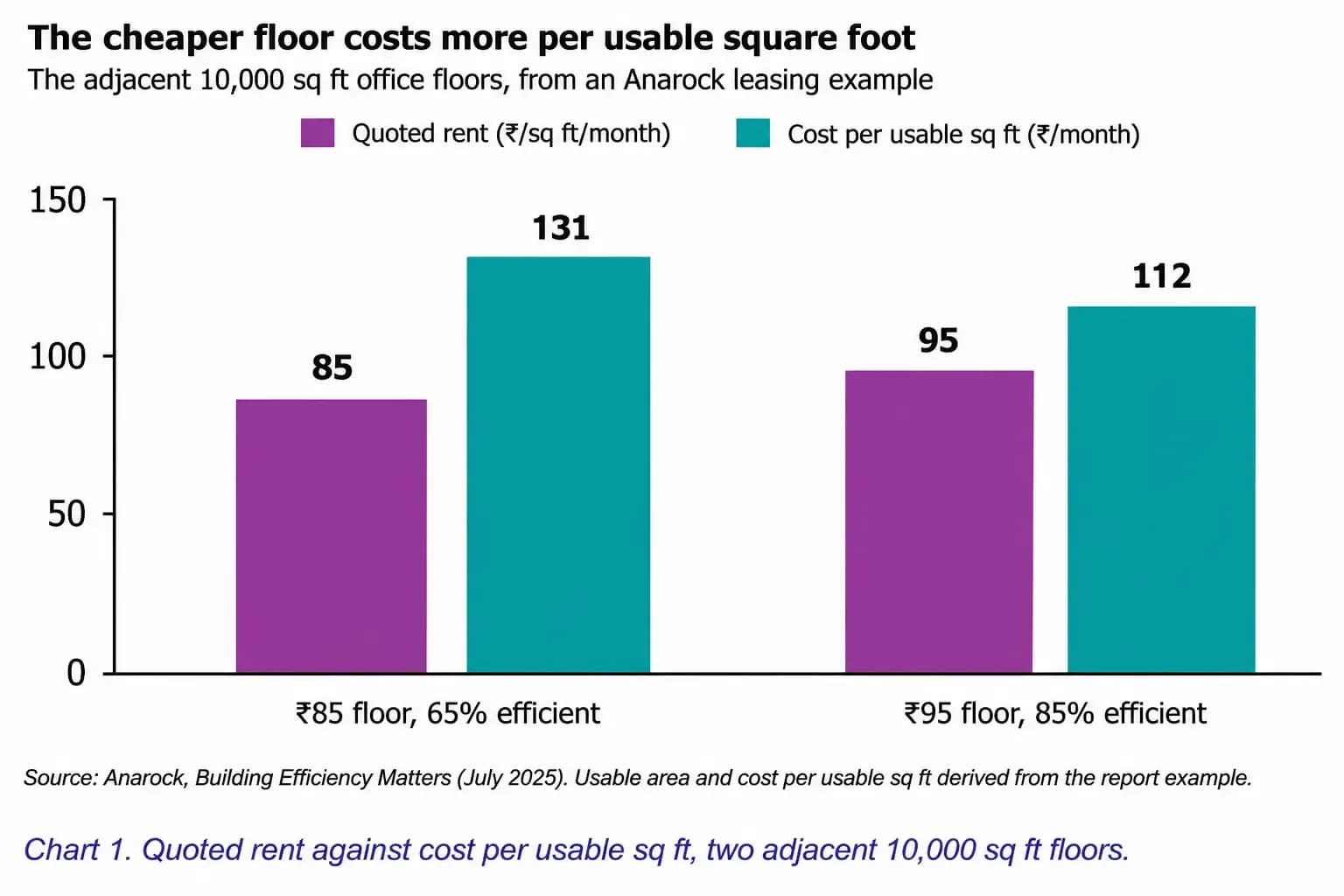
- A lower rent per sq ft can cost more per usable seat. Two adjacent 10,000 sq ft floors were quoted at ₹85 and ₹95; the cheaper floor was 65% efficient against 85%, and spent about 20% more on fit-out (Anarock, Building Efficiency Matters).
- Price the lease on usable area and all-in cost: budget the deposit, common-area maintenance, about 15% escalation every three years, and a build-out a less efficient building makes roughly 20% larger.
- Build growth into the lease: flexible, operator-run space is now 25% of leasing, up from 22%, and expansion rights let a footprint follow headcount without a second move.
Introduction
A company leasing office space in India once chose a building the way it chose a commodity, pressing landlords down on the quoted rent and moving on. That has changed. The market has tightened: net absorption, the space newly occupied once vacated space is netted off, has run ahead of new supply, and the terms a tenant signs now carry more weight than the discount won on rent.
Across the top seven cities in the first half of 2026, average Grade A rent rose 9% to ₹96 per sq ft per month while vacancy fell to 15%, from 16.3% a year earlier (India Office Market Update, H1 CY2026). The lease-or-own question sits upstream of all of this and is covered separately in the Anarock read on whether to lease or buy office space; what follows assumes the lease decision is already made. Five checks then separate a good lease from a costly one, and the first is settled before a term sheet is ever read: where the office sits.
Location decides who can reach the office
A company commits to its talent and its clients long before it signs a lease, and the address is where those commitments become a daily commute. The practical test is reach: how a typical employee gets to the desk, how a client gets to a meeting, and whether both can do it on public transport. A micro-market one metro stop closer to where people live can do more for retention than a rent saving, because a hard commute is paid in attrition.
The city sets the starting price, and the spread is wide: Grade A rent runs from about ₹154 per sq ft per month in the Mumbai Metropolitan Region down to roughly ₹66 in Kolkata, more than twofold for the same grade of stock (India Office Market Update, H1 CY2026). Vacancy is the counterweight: where empty space is plentiful, a tenant can press for a rent-free setup period and capped escalations, while a tight micro-market hands pricing power to the landlord. For occupiers, the location call is really two decisions in order - the city that fits the business, then the sub-market where the commute and the vacancy still leave room to negotiate. That trade-off runs through the Anarock read on choosing the right long-term location.
A lower rent per sq ft can be the costlier lease
Rent is quoted per square foot of leasable area, but a team works only in the usable space inside it, and the distance between the two decides what occupation costs. Building efficiency captures that distance: the carpet area a tenant can occupy as a share of the super built-up area the rent is charged on. A floor at 85% efficiency hands over 85 usable sq ft for every 100 leased; a floor at 65% hands over 65, and the tenant pays the same rent on the 35 it cannot use.
The Anarock Building Efficiency Matters study turns that into a bill. Two companies took adjacent 10,000 sq ft floors on the same street, one quoted ₹85 per sq ft and the other ₹95. By year end the company on the lower rent had spent about 20% more on fit-out, the interior build-out that turns a bare floor into a working office. It was also working out of a more crowded space, because its building ran at 65% efficiency against the other’s 85% (Building Efficiency Matters, July 2025). The cheaper headline rent bought less usable space and cost more to make workable.
Table 1. The same ₹10 rent gap, read two ways, on two adjacent 10,000 sq ft floors
| Measure | Floor quoted at ₹85 | Floor quoted at ₹95 |
|---|---|---|
| Quoted rent (₹/sq ft/month) | 85 | 95 |
| Building efficiency | 65% | 85% |
| Usable area on a 10,000 sq ft lease | 6,500 sq ft | 8,500 sq ft |
| Cost per usable sq ft (₹/month, derived) | about 131 | about 112 |
| Fit-out spend | about 20% higher | base |
Reading efficiency in India is harder than reading rent. Mature markets codify it, the United States through its Building Owners and Managers Association standard and the United Kingdom through the Royal Institution of Chartered Surveyors method, so a tenant can compare buildings on one basis. India has no equivalent, so the same building can be marketed at 80% efficiency in one cycle and 70% in the next, with no structural change. That lets a landlord quote a lower rent per sq ft while holding the rent per usable sq ft as high or higher. A quoted efficiency figure is therefore a claim, not a fact: neither carpet area nor super built-up area is defined the same way across states, and commercial leasing sits outside the area-disclosure rules that cover housing.
Scale makes the number worth chasing. On a 100,000 sq ft requirement, a five-point drop in efficiency is 5,000 sq ft of paid-for space that returns nothing, every month for the length of the lease. For tenants, the first figure to normalise is not the rent but the efficiency behind it: ask for the carpet area in writing, price the lease on the space a team can actually occupy, and read a low rent on a low-efficiency floor as the more expensive option it usually is.
What the quoted rent leaves the tenant to pay
Even priced on usable area, the quoted rent is only the first line of what a lease costs, because the figure Anarock reports is for a defined shell. The ₹96 pan-India rent is quoted for vacant space with a core facility, high-side air conditioning and full power back-up (India Office Market Update, H1 CY2026); anything the business needs beyond that shell lands in the tenant budget, not the rent line.
Three recurring costs sit on top, and each has a clause that moves it. A refundable deposit of six to twelve months of rent is locked up for the term. Common-area maintenance (CAM), the tenant’s share of running the lobbies, lifts and services, is billed on top and reconciled against actuals, so its basis matters as much as its rate. And the rent escalates, typically about 15% every three years, so the rent signed is not the rent paid in year five; the Anarock reads on the key clauses to look for in a commercial lease and on negotiating CAM charges set out the wording to press on. The number to model is the all-in cost across the lock-in, and the length of that lock-in is a bet on how much space the business will need years from now.
Space the business can grow into without moving
A lease is a multi-year commitment made on a single year’s headcount, which is why the room to expand matters as much as the space taken on day one. A fast-growing team that signs for exactly what it needs today will be renegotiating, or relocating, inside the lock-in, and a mid-term move carries a second build-out and fresh disruption. The cheaper path is to build the growth in: the right to take adjacent floors as they fall vacant, a right of first refusal on them, and a phased take-up that matches rent to headcount.
Where growth is genuinely uncertain, the flexible-space market absorbs it without committing capital. Flexible and managed offices, operator-run space leased by the seat rather than the floor, now account for 25% of office leasing, up from 22% a year earlier (India Office Market Update, H1 CY2026). A managed office is often cheaper for a short or unpredictable horizon, with no fit-out outlay and a shorter commitment; a conventional lease is usually cheaper per seat once the team is large and the hold is long. The occupiers whose plans move most already lean this way: deals above 0.1 mn sq ft made up 59% of leasing in H1 CY2026, and global capability centres took 45% of gross leasing. What makes a footprint scalable is written into the lease: adjacent-space rights, a flex option, and a lock-in short enough to let it follow headcount. That same lease commits the tenant to the building itself, whose day-to-day running is the next cost the quoted rent does not show.
How well the building runs, and what it costs to fit out
A building earns its rent in the services a tenant never negotiates but pays for every day, from power back-up to the condition the floor is handed over in. The rent definition itself assumes full power back-up and high-side air conditioning, so a building that falls short pushes the cost of closing that gap onto the tenant, in diesel, in extra cooling and in downtime. The checks that decide the running cost are unglamorous: the power back-up ratio, the building systems behind the walls, the parking against headcount, and whether the base build carries a credible green certification that will matter to staff and to the next sub-tenant.
The handover condition then sets the capital bill. A warm shell, delivered with flooring, a ceiling and basic services, needs far less work than a bare shell, and efficiency compounds the difference, because a less efficient floor needs the roughly 20% larger fit-out seen earlier to seat the same team. The building that is cheapest to occupy, then, is rarely the one with the lowest quoted rent; it is the one whose services and handover leave the least for the tenant to fix. Where an existing office is the alternative, the same arithmetic drives the Anarock read on refurbishment against relocation.
Key takeaways
The five checks resolve into one rule: measure a lease by what it costs to occupy usable space over the lock-in, which a low quoted rent can hide. Run in order - location and usable space to shortlist, then cost, scalability and services to negotiate - they keep a tenant bargaining from evidence rather than from the quoted rent, the one number a landlord most wants the decision to rest on.
- Choose the city for the business and the micro-market for the commute and the negotiating room; prime rent spans more than twofold, from about ₹154 per sq ft per month in MMR to ₹66 in Kolkata.
- Price the lease on usable space: at 65% efficiency against 85%, the floor with the lower quoted rent needed roughly 20% more fit-out.
- Model the all-in cost across the lock-in, not the first-year rent: the deposit, the CAM basis, and about 15% escalation every three years.
- Build growth into the lease through expansion rights and flexible space, now 25% of leasing, and judge the building on services and handover, not the headline number.
Where this sits at Anarock
In our commercial leasing and advisory work, we advise occupiers on exactly these checks: the site search, the efficiency and cost benchmarking, and the negotiation on the clauses that move the all-in number. For the market this decision sits in, see the Anarock reads on the H1 CY2026 office market and the 2026 office market outlook.
Frequently asked questions
What are the most important factors to consider when leasing office space in India?
Five checks decide whether an office lease is a good one: the location and micro-market, the usable space the rent actually buys, the cost beyond the rent, the room to grow, and how well the building runs. The market has tightened, with prime rent up 9% to ₹96 per sq ft per month and vacancy at 15% in H1 CY2026, so what a tenant verifies before signing now matters more than the discount won on the quoted rent.
Why can a lower rent per square foot be more expensive to occupy?
Because rent is charged on leasable area but a team works only in the usable space inside it. In one Anarock example, two adjacent 10,000 sq ft floors were quoted at ₹85 and ₹95; the cheaper floor was 65% efficient against the other’s 85%, and needed about 20% more fit-out to seat the same team.
What is building efficiency, and how is it measured in India?
Building efficiency is the carpet area a tenant can occupy as a share of the super built-up area the rent is charged on, so an 85% floor gives 85 usable sq ft for every 100 leased. India has no standard method for it, unlike the United States or the United Kingdom, so the same building can be marketed at different efficiency ratios in different cycles. Ask for the carpet area in writing and treat a quoted efficiency figure as a claim to verify.
What costs come on top of the quoted office rent?
The quoted rent covers a defined shell: vacant space with a core facility, high-side air conditioning and full power back-up. On top of it a tenant funds a refundable deposit of six to twelve months, common-area maintenance on the lobbies, lifts and services, the fit-out, and rent escalation of about 15% every three years. Budget the all-in cost across the lock-in, not the first-year rent.
Is a managed or flexible office cheaper than a conventional lease?
It depends on the horizon and the team size. Flexible and managed offices, operator-run space leased by the seat, now make up 25% of office leasing and carry no fit-out outlay and a shorter commitment, so they are usually cheaper for a short or uncertain requirement. A conventional lease is usually cheaper per seat once the team is large and the hold is long.
Does Anarock advise on commercial office leasing?
Yes. The Anarock commercial leasing and advisory practice advises occupiers on the site search, the efficiency and cost benchmarking, and the negotiation on the clauses that move the all-in cost, drawing on the first-party data behind this piece. It works with occupiers across the top seven cities and the wider India office market.
Sources
- Anarock Research, India Office Market Update, H1 CY2026, top seven cities, Grade A, data to 30 June 2026 - rent, vacancy, city spreads, the flexible-space and large-deal shares, and the rent definition used throughout.
- Anarock Corporate Leasing and Advisory, Building Efficiency Matters (July 2025) - the adjacent-floor efficiency example, the fit-out gap, and the measurement standards used in India and abroad.
- Anarock, Commercial real estate in India: the 2026 office market outlook - the wider market context for the leasing decision.